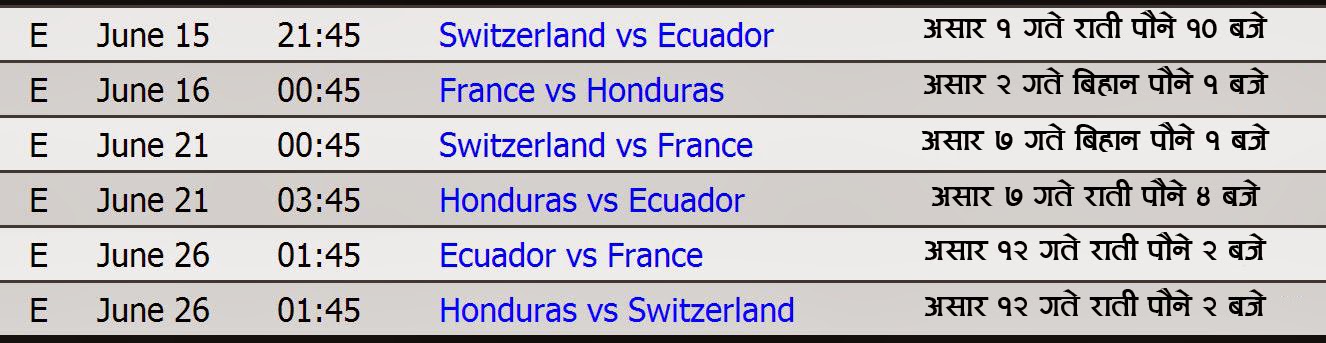
world cup 2014 schedule in nepali times and excel sheet


FIFA 2014 World Cup is the 20th edition of FIFA World Cup.  FIFA 2014 World Cup is starting on the 12th June 2014 and ends on 13th July 2014. According to Nepali calendar, it starts from the date of 2071 Jestha 29 and ends with 2071 Asar 29. Here is the FIFA World Cup 2014 Schedule in Nepali Time or in Nepali Standard Time (NST) that is +5:45 GMT. There are 32 participating nations in this biggest soccer event, FIFA 2014 World Cup. All the game matches FIFA 2014 World Cup are scheduled between 12th June 2014 and 13th July 2014. According to Nepali calendar match schedule are from 2071 Jestha 29 to Asar 29  in 32 days. Watch here FIFA World Cup 2014 Schedule in Nepali Time. More detail are available in official website of FIFA.
There are thousands of blogs and sites which are showing the game schedule FIFA World Cup 2014 but all are in Brazil local time. We found that many Nepalese people are searching the schedule in Nepali Standard Time. And we are written FIFA World Cup 2014 Schedule in Nepali Time or in Nepali Standard Time. Match schedule for first round, round of sixteen, quarter final, semi final and final are here in Nepali Standard Time. We have written here all the matchs of FIFA World Cup 2014 Schedule in Nepali Time.
FIFA 2014 World Cup group stage matches, the first round of the cup, will play in league format. All teams of FIFA World Cup 2014 are categorized into eight groups. There are four teams in each group and each team will play against other threes in their group.
FIFA World Cup 2014 round of sixteen matches was scheduled between 28th June 2014 and 1st July 2014. The final match of FIFA World cup 2014 is scheduled on 14th July 2014 at 12:45 AM in Nepal Standard Time.
There are many sites listed FIFA world cup 2014 match schedule, written in Brazil Local Time, that is -3:00 GMT. Nepali Standard Time is +5:45 GMT and complete match schedule listed here is in Nepali Standard Time. Some matches will show one day later than listed in other websites, because in Nepali Standard Time, those matches are after 12:00 am (Midnight).
असार ५ गते बिहान १ बजे भन्नाले असार ४ गतेकै रातीको १ बजे भन्ने बुझिन्छ ।


Rampur Municipality ( Rampur Palpa)

Rampur Palpa


Rampur Municipality 


१ सय २० किमि दूरी कम(rampur palpa)

उत्तर-दक्षिण जोड्न कालीगण्डकी नदीमा दोस्रो पक्की पुल निर्माण अन्तिम चरणमा छ । जसले, स्याङ्जाको साँखर र पाल्पाको दर्छा जोड्छ । । डेक राख्न र फिनिसिङ्को काम मात्र बाँकी रहेको पुल वैशाखभित्र उद्घाटन गर्ने योजना रहेको डिभिजन सडक कार्यालयले जनाएको छ । उक्त पुलका कारण तानसेन, बुटवल हुँदै पोखरा पुग्न ७० र काठमाडौं १ सय २० किमि दूरी कम हुनेछ । पोखरा, तनहुँ र पाल्पा हुँदै नवलपरासीस्थित पूर्वपश्चिम राजमार्ग जोड्न उक्त पुलले सहज बनाउने छ । 'लामो समयको सपना बल्ल पूरा भएको छ,' पाल्पा दर्छाका डोलराज पाठकले भने । अहिले पाल्पाबाट काठमाडौं पुग्न ३ सय ७० किमि दूरी पर्छ । पुल बनेपछि २ सय ३५ किमिमै पुगिनेछ । हाल १ सय ५० रुपैयाँ भाडा लाग्छ । दूरी छोट्टएिपछि ७ सय ५० मात्र तिरे पुग्छ । पाल्पाको पूर्वी, तनहुँको पश्चिम-दक्षिण भेग, नवलपरासीको उत्तरी पहाडी गाविस र स्याङ्जाको पूर्वका बासिन्दा यसबाट लाभान्वित हुनेछन् । ६ वर्षअघि निर्माण सुरु भएर ४ दशमलव २५ मिटर चौडाइ र १ सय ६६ मिटर लम्बाइको पुल निर्माण अन्तिम चरणमा पुगेको हो । डिभिजन सडक कार्यालय प्रमुख कर्णबहादुर रानाभाटका अनुसार यसका कारण पाल्पा, स्याङ्जा, तनहुँ र नवलपरासीका करिब १० लाख बासिन्दा प्रत्यक्ष लाभान्वित हुन्छन् भने नारायणगढ र पोखरा पुग्न सहज हुनेछ ।
यस क्षेत्रमा उत्पादित तरकारी, फलफूल र जडीबुटीलाई बजार पुर्‍याउन सहज हुने भएको छ । पुल निर्माणपछि तनहुँ खैरेनीटारदेखि भिमाद हुँदै केलादीघाट हुँदै रामपुरसम्म सोझो यात्रा हुनेछ । पाल्पा रामपुरबाट मित्याल हुँदै अरुणखोला र नवलपरासी कावासोती, रजहर, दलदले, गैंडाकोट निस्किने सडकको ट्रयाक खुलिसकेकाले तराई जोड्ने अर्को मार्गसमेत बन्नेछ । रामपुरका कृष्णकुमार अर्यालले तानसेन भएर बुटवल, पोखरा, काठमाडौं, नारायणघाट जानुपर्ने बाध्यता हट्ने बताए । अर्का मित्र "दीपक के सी "" भन्नुहुन्छ --अहिले मोटरसाइकल हरु हामीले झोलुंगे पुलदेखि जाने र आउने गरेका छौ पुल बेस्सरी हल्लिन्छ त्यो पुल तयार भएसी त धेरै मजा आउने तथा पोखरा ,काठमान्डू जानको लागि एकदम सजिलो पर्ने बताउनु हुन्छ 'रामपुरबाट सीधै काठमाडौं र पोखरा बस सेवा सञ्चालन गर्न सकिनेछ,' उनले भने, 'घुमेर जानु पर्दैन, यात्रा छोटो र सहज हुन्छ ।' तानसेन पुगेर पोखरा, काठमाडांै र तराई जाने समय बचत हुने उनले बताए । यात्रा चार घन्टा छिटो हुनेछ । उक्त पुललाई मध्यनजर गर्दै रामपुरका बासिन्दाले यातायात व्यवसायी समितिसमेत गठन गरिसकेका छन् । १ सय २० बाट ६५ किमिमात्र पुलका कारण तनहुँ र कास्कीका बासिन्दालाई नवलपरासीको दलदले निस्किन करिब ५५ किमि छोटो पर्छ । तनहुँ खैरेनीटारबाट मुग्लिन, नारायणघाट र दलदले पुग्न करिब १ सय २० किमियात्रा तय गर्नुपर्नेमा करिब ६५ किमिमै पुगिन्छ । पोखरा आउने पर्यटकलाई समेत दलदले हुँदै लुम्बिनी पुग्न १ सय २० किमि छोटो हुनेछ । 'ग्रामीण क्षेत्रका अदुवा र सुन्तला दलदले पुर्‍याउन सजिलो हुनेछ,' पुल नजिकको गजरकोट केलादीघाटका ५२ वषर्ीय राजन पोखरेलले भने, 'सडक विस्तारलाई प्राथमिकता दिए पर्यटक र कृषकलाई धेरै फाइदा हुनेछ ।' उक्त क्षेत्रको अदुवा र बेसारको मुख्य व्यापारिक स्थल दलदले भएकाले आफूहरूलाई सहज हुने उनले बताए । उद्योग वाणिज्य संघ खैरेनीटार बजार एकाइका पूर्वअध्यक्ष समुन्द्रराम श्रेष्ठका अनुसार नारायणघाट-मुग्लिन सडकमा सवारी भारसमेत कम हुनेछ । स्याङ्जाको साखरबाट भिमाद हुँदै पोखरा र काठमाडौंका लागि १० वर्षदेखि यातायात सञ्चालन भइरहेको छ । हालसम्म स्याङ्जाका साँखर , चापाकोट, रत्नपुरलगायत आधा दर्जन गाविसका बासिन्दाले चापाकोट, गल्याङ हुँदै बुटवल र नारायणगढ पुग्नुपर्ने बाध्यता थियो । 'अब त रामपुर हुँदै छोटो बाटो बुटवल जान पाइने भयो,' साँखरका प्रमोद पोखरेलले भन्नुहुन्छ , 'पुलले पाल्पा,नवलपरासी र तनहुँसँग व्यापारिक सम्बन्ध पनि जोडिने छ ।' हालसम्म सिद्धार्थ राजमार्गबाट गल्याङ बजारमा पुर्‍याएर बुटवलका लागि तरकारी र फलफूल निकासी हुँदै आएको थियो । अब रामपुर हुँदै बुटवल लान सहज हुने छ । 'हामीलाई यस पुलले आशावादी बनाएको छ,' साँखरका कृषक कमल अधिकारीले भने । साँखरबाट गल्याङ हुँदै बुटवल पुग्न ६/७ घन्टा लाग्नेमा रामपुर आर्यभञ्ज्याङ हुँदै ४ घन्टामा पुग्न सकिनेछ ।

Rampur Municipality


सरकारले विभिन्न जिल्लाका सदरमुकाम र नगरोन्मुख गाविसलाई जोडेर ७२ वटा नयाँ नगरपालिका घोषणा गरेको छ । हाल ५८ नगरपालिका रहेकामा सरकारले नयाँ ७२ वटा थपेर १ सय ३० वटा पुर्‍याएको छ । २०६८ को बजेट वक्तव्यमा घोषणा भए पनि कार्यान्वयन हुन नसकिएका ४१ नगरपालिकासमेत ७२ वटामै समेटिएका छन् ।


मन्त्रिपरिषदको बिहीबार बसेको बैठकले स्थानीय विकास मन्त्रालयको थप ७२ वटा नगरपालिका गठन र सञ्चालन गर्ने प्रस्ताव स्वीकृत गरेको जानकारी सरकारका प्रवक्ता एवं सूचना तथा सञ्चारमन्त्री डा मिनेन्द्र रिजालले दिए ।


नयाँ घोषणासँगै मुलुकमा नगरपालिका भएका जिल्लाको संख्या ६२ वटा पुगेको छ । यसअघि ४३ जिल्लामा मात्र नगरपालिका थिए । अब नगरपालिका नभएका जिल्ला १३ वटामात्र बाँकी छन् । २ सय ८३ वटा गाविसलाई जोडेर नयाँ ७२ वटा नगरपालिका बनाइएको हो । अब मुलुकमा गाविसको संख्या घटेर ३ हजार ६ सय ३३ पुगेका छन् ।


सरकारले जनसंख्या १० हजारभन्दा बढी भएका, बिजुली, सडक, खानेपानी र सञ्चार सुविधा पुगेका क्षेत्रलाई नगरपालिका घोषणा गरेको हो । थप ७२ वटा नगरपालिकाले मुलुकको ७.०८ प्रतिशत भूभाग ओगटेका छन् भने तिनमा कुल जनसंख्याको २५.५६ प्रतिशतको बसोबास छ । नयाँ नगर घोषणासँगै १ सय ३० नगरपालिकामा बस्ने जनसंख्या १ करोड १२ लाखभन्दा बढी छ ।


नयाँ नगरपालिका घोषित भएकामा १९ वटा जिल्ला सदरमुकाम छन्, जसमा वरपरका गाविसलाई समेत जोडिएको छ । सदरमुकाम र वरपरका गाविस जोडेर नगरपालिका बनाइएकामा ताप्लेजुङको ताप्लेजुङ, पाँचथरको फिदिम, तेह्रथुमको म्याङ्लुङ, भोजपुरको भोजपुर, खोटाङको दिक्तेल, सिन्धुपाल्चोकको चौतारा, धादिङको नीलकण्ठ, पर्वतको कुस्मा, गुल्मीको रेसुङ्गा, अर्घाखाँचीको सन्धिखर्क, सल्यानको शारदा, अछामको मंगलसेन, लमजुङको बेंसीसहर, बझाङको जयपृथ्वी, जुम्लाको चन्दननाथ, प्युठानको प्युठान, संखुवासभाको चैनपुर, ओखलढुंगाको सिद्धिचरण, म्याग्दीको बेनी र दार्चुलाको अपी छन् । हाल विद्यमान नगरपालिकामा थप ३ गाविस गाभ्ने प्रस्ताव भने कार्यान्वयन हुन सकेको छैन ।


सबभन्दा बढी नगरपालिका नवलपरासी, मोरङ र झापामा थपिएका छन् । नवलपरासीमा ७, मोरङमा ६ र झापामा तीनवटा थपिएका छन् । नवलपरासीमा सुनवल, कावासोती, देवचुली, बर्दघाट, सैनामैना र लुम्बिनी सांस्कृतिक र गैंडाकोट तथा मोरङमा बेलवारी, पथरी-शनिश्चरे, कोसी-हरैचा र रंगेली र झापामा बिर्तामोड, शनि-अर्जुन र कन्काई छन् ।


उदयपुरको कटारी र बेल्टार-बसाहा, सप्तरीको शम्भुनाथ, सर्लाहीको हरिवन, रौतटहको चन्द्रपुर (चन्द्रनिगाहापुर), बाराको गढीमाई, काभ्रेको पाँचखाल, तनहुँको शुक्लगण्डकी (दुलेगौंडा, खैरेनीटार), र बन्दीपुर, बाँकेको कोहलपुर, अछामको साँफेबगर, सप्तरीको कञ्चन रूप, सिराहाको मिर्चैया, धनुषाको धनुषाधाम र छिरेश्वरनाथ, महोत्तरीको गौशाला, बर्दियाको राजापुर, इलामको सूर्योदय, सुनसरीको दुहवी-भलुवा, सर्लाहीको लालबन्दी र ईश्वरपुर, मकवानपुरको थाहा (पालुङ, दामन र बज्रबाराही गाविस), बाराको निजगढ, चितवनको खैरहनी र चित्रवन, स्याङ्जाको चापाकोट, पाल्पाको रामपुर, रूपन्देहीको देवदह र तिलोत्तमा, कपिलवस्तुको कृष्णनगर, शिवराज, दैलेखको दुल्लु र कञ्चनपुरको बेलौरीलाई नगरपालिका घोषणा गरिएको छ ।


उपत्यकामा चार नगर थपिने


सीमा विवादका कारण्ा ४ वटा उपत्यकाका प्रस्तावित नगरपालिका घोषण्ाा हुन सकेनन् । रामेछापको मन्थली, काठमाडौंको शंखरापुर, ललितपुरको कार्यविनायक र चम्पापुर नगरपालिकाको विवाद निरुपण्ा गरी अन्य पूर्वाधार पुगेका गाविसको नगरपालिका गठनका लागि सरकारले प्राध्यापक केशवानन्द गिरीको संयोजकत्वमा नगर क्षेत्र निर्धारण्ा तथा सिफारिस समिति गठन गरेको छ ।


समितिमा मन्त्रालयको नगरपालिका महाशाखा हेर्ने सहसचिव, शहरी विकास मन्त्रालयका सहसचिव, नापी विभागका उपमहानिर्देशक, नगरपालिका संघका अध्यष तथा मन्त्रालयको नगरपालिका शाखाका उपसचिव सदस्य सचिव छ । समितिलाई एक महिनाको समयसीमा तोकिएको छ ।


२०५९ मा सूर्यमान अमात्य संयोजकत्वको नगरक्षेत्र निर्धारण समितिले बुझाएको प्रतिवेदनलाई आधार मानेर सरकारले २०६८ को बजेट वक्तव्यमा ४१ नगरपालिका घोषणा गरेको थियो । तर स्थानिय विवादका कारण ती नगरपालिका कार्यान्वयन हुन सकेका थिएनन् । थप नगरपालिका घोषणाका लागि २०६८ मा प्राध्यापक पद्मचन्द्र पौडेलको संयोजकत्वमा गठित समितिले गत वर्ष प्रतिवेदन बुझाएको थियो । त्यही प्रतिवेदनका आधारमा मन्त्रिपरिषदले स्विकृत गरेपछि विहीवार नया नगरपालिका घोषणा भएका हुन् ।


उपत्यकामा भने नयाँ नगरपालिका घोषणा हुन सकेन । गत वर्ष गठित प्राध्यापक पौडेल संयोजकत्वको नगर निर्धारण समितिले उपत्यकाका गाविसहरूको विवाद टुंग्याउन नसकेकाका कारण २०५९ मा सिफारिस भएका नगरपालिका पनि कार्यान्वयन हुन सकेनन् ।


सूर्यमान अमात्य संयोजकत्वले नगरक्षेत्र निर्धारण समितीले २०५९ मै ललितपुरको कार्यविनायक र चम्पापुर तथा काठमाडौंको शंखरापुरलाई नगरापलिका घोषणा गर्न सिफारिस गरेको थियो । अमात्य संयोजकत्वको प्रतिवेदनलाई आधार मानी ९ वर्षपछि गत २०६८ मा बजेट वक्तव्यमा सरकारले थप ४१ वटा नगरपालिका घोषणा गरेको थियो । विवादका कारण रामेछाप समेत गरेर चारवटा प्रस्तावित नगरपालिका कार्यान्वयनमा आएनन् ।


स्थानीय विकास मन्त्रालयका प्रवक्ता दिनेश थपलियाले नयाँ समितिले गरेको सिफारिसका आधारमा उपत्यकासहित अन्य जिल्लाका गाविसलाई नगरपालिका बनाइने जानकारी दिए । 'नगरपालिकाको मापदण्डमा पुगे पनि घोषणा हुन नसकेका गाविसहरूलाई दृष्टिगत गरी सिफारिस समिति गठन गरिएको हो' उनले भने ।


- See more at: http://www.ekantipur.com/np/2071/1/25/full-story/388826.html#sthash.pdPLm0ub.dpuf

Mount Everest

The Everest region is located in the northeast of Nepal. The 10-day walk through the middle hills of Solu to the higher altitudes of Khumbu to the base of Sagarmatha, or Mt. Everest, the world’s highest peak, is an opportunity to observe
and participate in the daily life of the legendary Sherpa people. The prime attraction – the 8,848 m peak of Mt. Everest – lies in Sagarmatha National Park, which is also home to two other eight thousanders – Lhotse and Cho Oyu – besides several other prominent peaks above 6,000 m.
Designated as a World Heritage Site in 1979, much of the 1,148 sq. km park lies above 3,000 m. The park is composed of rugged terrain with deep gorges, glaciers and huge rocks. The vegetation in the park changes from pine, hemlock, fir, juniper, birch, rhododendron and shrubs to alpine plants and then to bare rock and snow. It is home to the ghoral, tahr, serow and musk deer as well as the impeyan pheasant, blood pheasant, red-billed chough and the yellow-billed chough.
The trail to Everest also begins at Lukla, the airport at 2,850 m. The trail climbs up the Dudhkoshi River Valley, and the following day brings you to the legendary Sherpa village of Namche Bazaar in the Khumbu (3,500 m), which is the staging point for expeditions to Everest and other peaks in the area. Above Namche lie the traditional villages Khunde and Khumjung. Khumjung which is the largest village in the Khumbu lies at the foot of the sacred peak Khumbila. The Khunde Hospital, maintained by Himalayan Trust, and Khumjung School, the original Hillary School set up in 1960, lie here.
of Across the canyon from Khunde, perched on a high ridge, is the Tengboche Monastery, the leading Buddhist center in the Khumbu. The monastery rests amid stunning views of Everest, Lhotse and Ama Dablam. Pines, azaleas and colorful mountain rhododendrons ring the attractive monastery. There are rest houses, lodges and camping sites here.From Tengboche you can continue on to Pheriche, Kala Pattar and the hamlet of Gorakshep.  From here, the site of Everest Base Camp is easily accessible, as is the summit of Kala Pattar (5,545 m), from which much of Mt. Everest is clearly visible. However, you must take time to properly acclimatize as the altitude gains are rapid.

Source: http://welcomenepal.com/promotional/tourist-destination/everest-region-2/


Rafting in Nepal

When it comes to white water rafting and kayaking, Nepal has the best on offer in the world. Nepal has rivers to cover every level of white water activity after the monsoon offers the most adrenaline packed rivers to all adventure seekers. This mountainous country spoils the adventure for choice when it comes to white water. Not only is rafting a great action adventure holiday, but it’s a great way to discover the beauty of Nepal. The rivers all originate high up in the Himalaya and snake there way downwards through some of the most spectacular scenery in the world. Not only do you get to see first hand Nepal’s nature but also you get to experience her ancient and unique culture as you raft through remote villages and farm land. Nepal’s selection of rivers covers a range of grades which accommodate everything from the ultimate adrenaline adventure, an action packed river ride to a fun family holiday.
Some of the remote rivers offer long rafting trips which incorporate some trekking. These kinds of trips are truly trips of a life time as you have to bring with you everything you need and be totally self reliant and sufficient. These rivers churn out their courses through some of the most pristine wilderness and isolated villages that Nepal has to offer.
Rafting is not the only option here. All of Nepal’s rives can be kayaked. The range of rivers in Nepal covers experienced to novice kayakers. For the first time kayaker, you can take time out and do a clinic to learn kayaking. These clinics cover everything form safety and technique to river craft. Can you imagine a better way to discover Nepal than by floating down its majestic rivers in your own kayak? What better way to get up close and personal with this stunning country?
In Nepal you will truly find some of the world’s most outstanding river journeys. As rafting and kayaking is an activity that needs to be arranged through our company, why not let Sarita Holidays Travels & Tours organize your trip for you? We guarantee a fun and adventure packed trip guided by the highest standard guides with the best equipment.

Latest Photo of Rampur Palpa


Immigration officials caught on camera accepting bribe

 The Commission for the Investigation of Abuse of Authority on Tuesday arrested five Immigration officials as they were caught on camera accepting bribe.
The anti-graft body arrested the officials at the Immigration Department with video footage showing the officials taking bribe from the service seekers.
Section Officers Surya Prasad Dahal and Devarsi Sapkota, non-gazette officers Pradip Prasad Lamichhane and Bishwa Raj Kharel and office assistant Jaya Narayan Napit have been arrested.

Norway's Prime Minister works as secret taxi driver - video

IMAGINE jumping in a taxi and finding the Prime Minister at the wheel. This is what several Norwegians discovered when their country's leader, Jens Stoltenberg, went undercover as a taxi driver.
In a bid to find out the real concerns of voters ahead of Norway's general election on 9 September, Stoltenberg wore an Oslo Taxi uniform for an afternoon and picked up passengers in a black Mercedes.
"It's important for me to hear what people really think. If there's one place where people say what they think, it's in the taxi," Stoltenberg said in a video posted on YouTube.


The stunt, which was carried out in June, was filmed by a hidden camera to record reactions from the passengers, including one who remarked: "From this angle, you really look like the Prime Minister."
Passengers, who were not charged for their journeys, discussed issues ranging from education and oil policy to the state of Stoltenberg's driving skills.
One passenger said the "driving is not exactly the best I've seen" after the Prime Minister, who had not driven in eight years, brought the automatic car to a sudden halt.
Asked by the tabloid Verdens Gang if he would become a taxi driver if he lost the elections, Stoltenberg said: "I think that the country and Norwegian taxi passengers are better served if I were a Prime Minister and not a taxi driver."
According to the latest opinion polls, Stoltenberg's ruling centre-left coalition appears likely to lose. But he did steer one voter in his party's direction. While climbing out of the taxi, an elderly male passenger told him: "This has been nice ... I will vote Labour Party."


Read more: http://www.theweek.co.uk/europe/54571/norways-prime-minister-works-secret-taxi-driver-video#ixzz2boiYRq5d

Rara Lake: Heaven on Earth is not just a cliche, after Rara

Kathmandu Valley

Kathmandu Valley comprises the three ancient cities of Kathmandu, Patan and Bhaktapur, which were once independent states ruled by the Malla kings from the 12th to the 18th centuries. The three cities house seven UNESCO World Heritage shrines which are together listed as a UNESCO World Heritage Site (Culture). The valley is also home to hundreds of other exquisite monuments, sculptures, artistic temples and magnificent art – reminders of the golden era in Nepal’s architecture.
Legend has it that the valley was was once a primordial lake ringed by verdant mountains.  In this pristine lake lived giant serpents until one fine day, saint Manjushree, the Bodhisatva, raised a mighty sword and in one fell swoop, cut open the side of a mountain at a place now known as Chobar. The voluminous waters of the lake gushed out, leaving behind a fertile valley capable of supporting large urban settlements over the millennia. The Gopala and Kirati dynasties were the earliest rulers here followed by the Licchavi (300-879 A.D.), under whom flourished trade and crafts.
But the valley’s remarkable cities with their ornate palaces, the superbly crafted pagodas and the monumental stupas are testimony of the artistic genius of the Newar craftsmen, the original inhabitants of the valley, whose skills were championed by the Malla kings and appreciated even by the Mongol rulers of 18th century China.


source http://welcomenepal.com/promotional/tourist-destination/around-kathmandu/

nepali Culture

Add caption
Customs and traditions differ from one part of Nepal to another. A conglomeration lies in capital city Kathmandu where cultures are blending to form a national identity. Kathmandu Valley has served as the country’s cultural metropolis since the unification of Nepal in the 18th Century.A prominent factor in a Nepali’s everyday life is religion. Adding color to the lives of Nepalis are festivals the year round which they celebrate with much pomp and joy. Food plays an important role in the celebration of these festivals.


Religion:

Nepal was declared a secular country by the Parliament on May 18, 2006. Religions practiced in Nepal are: Hinduism, Buddhism, Islam, Christianity, Jainism, Sikhism, Bon, ancestor worship and animism. The majority of Nepalis are either Hindus or Buddhism. The two have co-existed in harmony through centuries.
Buddha is widely worshipped by both Buddhists and Hindus of Nepal. The five Dhyani Buddhas; Vairochana, Akshobhaya, Rathasambhava, Amitabha and Amoghasiddhi, represent the five basic elements: earth, fire, water, air and ether. Buddhist philosophy conceives these deities to be the manifestations of Sunya or absolute void. Mahakaala and Bajrayogini are Vajrayana Buddhist deities worshipped by Hindus as well.
Hindu Nepalis worship the ancient Vedic gods. Bramha the Creator, Vishnu the Preserver and Shiva the Destroyer, are worshipped as the Supreme Hindu Trinity. People pray to the Shiva Linga or the phallic symbol of Lord Shiva in most Shiva temples. Shakti, the dynamic element in the female counterpart of Shiva, is highly revered and feared. Mahadevi, Mahakali, Bhagabati, Ishwari are some of the names given. Kumari, the Virgin Goddess, also represents Shakti.Other popular deities are Ganesh for luck, Saraswati for knowledge, Lakshmi for wealth and Hanuman for protection. Krishna, believed to be the human incarnation of Lord Vishnu is also worshipped widely. Hindu holy scripts Bhagawat Gita, Ramayan and Mahabharat are widely read in Nepal. Vedas, Upanishads and other holy scriptures are read by well learned Brahmin Pundits during special occasions.


Customs:

The diversity in Nepal in terms of ethnicity again makes room for various sets of customs. Most of these customs go back to the Hindu, Buddhist or other religious traditions. Among them, the rules of marriage are particularly interesting. Traditional marriages call for deals arranged by parents after the boy or girl come of age.
Nepalis do not eat beef. There are several reasons for this, one being that the Hindus worship cow. Cow is also the national animal of Nepal. Another interesting concept among Nepalis is division of pure and impure. “Jutho” referring to food or material touched by another’s mouth directly or indirectly, is considered impure by Nepalis. Nepalis consider cow dung to be pure for cleansing purposes. During menstruation women are considered impure and hence, are kept in seclusion until their fourth day purification bath.Nepal is a patriarchal society. Men usually go out to work while women are homemakers. However, in cities, roles can differ. Most Nepalis abide by the caste system in living habits and marriage. Rural Nepal is mostly agrarian, while some aspects of urban life carry glitz and glamour of the ultra-modern world.


Food:

Nepal does not have a distinct cooking style. However, food habits differ depending on the region. Nepali food has been influenced by Indian and Tibetan styles of cooking. Authentic Nepali taste is found in Newari and Thakai cuisines. Most Nepalis do not use cutlery but eat with their right hand.The regular Nepali meal is dal (lentil soup), bhat (boiled rice) and tarkari (curried vegetables), often accompanied by achar (pickle). Curried meat is very popular, but is saved for special occasions, as it is relatively more expensive. Momos (steamed or fried dumplings) deserve a mention as one of the most popular snack among Nepalis. Rotis (flat bread) and dhedo (boiled flour) also make meals in some homes.


Source http://welcomenepal.com/promotional/know-nepal/culture/


Plants in Nepal

Of the total number of species found globally, Nepal possesses 2.80 percent plants. Record from 2006 shows that Nepal has 6,391 flowering plant species, representing 1,590 genera and 231 families. Nepal’s share of flowering plant species is 2.76 percent of the global total compared to earlier records of 2.36 percent. Nepal’s share of pteriodophytes is 5.15 percent compared to earlier records of 4.45 percent.
There are 2,532 species of vascular plants represented by 1,034 genera and 199 families in the protected sites. Some 130 endemic species are found in the protected sites.

For ecology and vegetation purpose Nepal could be divided into four floristic regions i.e.
(a) western
(b) north-western
(c) central, and
(d) eastern, and bio-climatically these are broken down into twenty regions from humid tropical climate to the arid, alpine regions.
There are 399 endemic flowering plants in Nepal of which about 63 percent are from the high mountains, 38 percent from the mid hills, and only 5 percent from the Terai and Siwaliks. Similarly, the central region contains 66 percent of the total endemic species followed by 32 percent in the western and 29 percent in the eastern regions.

Medicinal Plants:
The Himalayas are famous for medicinal plants and have even been mentioned in the Aurveda. Many of the herbs and plants found in the Himlayas are used in traditional healing systems like Ayurvedic, Homoeopathic, Amchi etc. Some of these plants are even used for allopathic medicine. Medicinal plants are abundantly found in: the Terai region of Nawalparasi, Chitwan, Bardia, Dhanusha, mid hill region of Makhwanpur, Syangja, Kaski, Lamgjung, Dolakha, Parvat, Ilam, Ramechhap, Nuwakot, and the Himalayan region of Dolpa, Mugu, Humla, Jumla, Manang, Mustang and Solukhumbu.


Orchids:
In ancient Rome, Theophrastus, a student of Plato, was intrigued by the sight of a plant with a pair of roots. Orchis was the name he gave them, the Greek word for testicles. Worldwide, there are some 500 to 600 genera and some 20,000 to 35,000 names, the largest of all plant families, and out of this, Nepal has 57 genera (27 Terrestrials and 30 Epiphytic) with a few Lithophytes.Nepal is endowed with an incredible variety of orchids scattered across the country. Dedrobium is the largest species, followed by Habenaria and Bulbophyllum. Anthogonium, Hemipilia and Lusia are some of the other varieties amongst the nearly two dozen single species families.

Source:-http://welcomenepal.com/promotional/know-nepal/plants/

Nepali Wildlife

Of the total number of species found globally, 3.96 percent mammals, 3.72 percent butterflies and 8.9 percent of birds. Wildlife of Nepal is officially classified into two main categories: common and protected. The common category lists such species as common leopard, spotted deer, Himalayan tahr, blue sheep and others. These species are commonly seen in the wild. The protected species include 26 mammals, nine birds and three reptiles. These rare animals are confined to their prime habitats.
Please click Protected Species for details. The endemic fauna are: Himalayan field mouse, spiny babbler, Nepali kalij, 14 herpetofauna, and six types of fishes.
Mammals:
Nepal has 185 species of mammals found in various parts of the country. Found in Nepal’s dense Terai jungles are exotic animals like the Asiatic elephant, the one-horned rhinoceros, the Royal Bengal tiger among others. Also found here are the leopard, monkey, langur, hyena, jackal, wild boar, antelope, wild cat, wolf,


sloth bear, chital or spotted deer and barking deer. Wild buffalo locally called “Arna” is found in the Koshi
Tappu region. The western Terai jungles of Suklaphanta is home of the of swamp deer, while the endangered blackbucks are found in the Bardia region. Nepal Government has made an effort to preserve blackbucks by declaring an area of 15.95 sq. km. in Bardia as Blackbuck Conservation Area.
Nepal even has its own variety of dolphins found in the fresh waters of Narayani and Karnali rivers. The Himalayan region is also home to the elusive snow leopard and the red panda. Red panda, a rare sight because of its shy nature, may be found from Langtang region to Kanchenjunga region. Other mammals that live in high altitude areas are yak, blue sheep, Himalayan tahr and musk deer.  While otters are found in the Rara region north west, the Dhorpatan hunting grounds is home of the blue sheep and Himalayan tahr.
Reptiles:
Nepal has two indigenous species of crocodile: the fish eating gharial with the long narrow snout and the marsh mugger which is omnivorous, eating anything it can catch. A very successful breeding project has brought the gharial back from extinction. Some of the snakes found in Nepal are: cobras, kraits, vipers and the Indian python. Other reptiles found in the country are turtles and monitor lizards. Some of these reptiles can be seen in the Chitwan National Park and Bardia National Park.
Birds:
Nepal has more than 850 recorded species of birds. Amazingly, half of these birds can be seen in and around the Kathmandu valley alone. The hills around the valley especially Nagarjun, Godavari and Phulchowki are popular birding areas. Phulchowki at 2,760 m boasts about 90 bird species including the endemic spiny babbler, which was thought to be extinct until it was spotted in Nepal. Another rare species of bird, the red-headed trogan, was also sighted here in April 2000.
National parks like Chitwan and Bardia harbor a wide variety of birds too. In Chitwan, endangered vultures are being protected from contaminated food by establishing “Vulture Restaurant” which feeds them safe carcasses. The Koshi Tappu region is home to a large species of resident and migratory birds. It has about 26 varieties of ducks alone. About 485 species have been sighted here, including black ibis, honey kites, ospreys, black headed orioles, peregrine falcon, partridges, ruddy shelduck, storks, vultures and eagles among others.In the higher Himalayan region are found different species of the raptors and birds of prey. Nepal’s national bird, the Danphe or impeyen pheasant, is also found in the Himalayan region. A rare bird known as jerdon’s baza was sighted in Nepal. Over the past few years a conservation group has worked specifically in the Lumbini area to conserve the sarus crane.
For more information about Nepal’s wildlife,

(official web site of the Department of National Parks & Wildlife Conservation, Ministry of Forests & Soil Conservation).


Source:- http://welcomenepal.com/promotional/know-nepal/wildlife/

Nepali Geography

Nepal is located in South Asia between China in the north and India in the south, east and west. While the total land area is 147,181 sq. km including water area of the country that is 3,830 sq. km. The geographical coordinates are 28°00′N 84°00′E. Nepal falls in the temperate zone north of the Tropic of Cancer.Nepal’s ecological zones run east to west about 800 km along its Himalayan axis, 150 to 250 km north to south, and is vertically intersected by the river systems. The country can be divided into three main geographical regions: Himalayan region, mid hill region and Terai region. The highest point in the country is Mt. Everest (8,848 m) while the lowest point is in the Terai plains of Kechana Kalan in Jhapa (60 m).
The Terai region, with width of ranging 26 to 32 km and altitude ranging from 60 -305 m, occupies about 17 percent of total land area of the country. Kechana Kalan, the lowest point of the country with an altitude of 60 m, lies in Jhapa district of the eastern Terai.The southern lowland Terai continues to the Bhabar belt covered with the Char Kose Jhadi forests known for rich wildlife. Further north, the Siwalik zone (700 – 1,500 m) and the Mahabharat range (1,500 – 2,700 m) give way to the Duns (valleys), such as Trijuga, Sindhuli, Chitwan, Dang and Surkhet. The Midlands (600 – 3,500 m), north of the Mahabharat range is where the two beautiful valleys of Kathmandu and Pokhara lie covered in terraced rice fields, and surrounded by forested watersheds.
The Himalayas (above 3,000 m) comprises mountains, alpine pastures and temperate forests limited by the tree-line (4,000 m) and snow line (5,500 m). Eight of the 14 eight-thousanders of the world lie in Nepal: Sagarmatha or Mount Everest (8,848 m), Kanchenjunga (8,586 m), Lhotse (8,516 m), Makalu (8,463 m), Cho Oyu (8,201m), Dhaulagiri (8,167 m), Manaslu (8,163 m) and Annapurna (8,091 m). The inner Himalayan valley (above 3,600 m) such as Mustang and Dolpa are cold deserts sharing topographical characteristics with the Tibetan plateau.Nepal holds the so called “waters towers of South Asia” with its 6,000 rivers which are snow-fed or dependent on rain. The perennial rivers include Mahakali, Karnali, Narayani and Koshi rivers originating in the Himalayas. Medium-sized rivers like Babai, West Rapti, Bagmati, Kamla, Kankai and Mechi originate in the Midlands and Mahabharat range. A large number of seasonal streams, mostly originating in Siwaliks, flow across the Terai.
Of 163 wetlands documented, the nine globally recognized Ramsar sites are: Koshi Tappu Wildlife Reserve, Beeshazarital (Chitwan), Jagdishpur Reservoir (Kapilvastu) Ghodaghodi Tal (Kailali) in the Terai, and Gokyo (Solukhumbu), Phoksundo (Dolpa), Rara (Mugu) and Mai Pokhari (Ilam) in the mountain region.There are more than 30 natural caves in the country out of which only a few are accessible by road. Maratika Cave (also known as Haleshi) is a pilgrimage site associated with Buddhism and Hinduism. Siddha Cave is near Bimalnagar along the Kathmandu-Pokhara highway. Pokhara is also known for caves namely Bats’ shed, Batulechar, Gupteswar, Patale Chhango. The numerous caves around Lo Manthang in Mustang include Luri and Tashi Kabum which house ancient murals and chhortens dating back to the 13th century.

Nepali History

Records mention the Gopalas and Mahishapalas believed to have been the earliest rulers with their capital at Matatirtha, the south-west corner of the Kathmandu Valley. From the 7th or 8th Century B.C. the Kirantis are said to have ruled the valley. Their famous King Yalumber is even mentioned in the epic, ‘Mahabharat’. Around 300 A.D. the Lichhavis arrived from northern India and overthrew the Kirantis. One of the legacies of the Lichhavis is the Changu Narayan Temple near Bhaktapur, a UNESCO World Heritage Site (Culture), which dates back to the 5th Century. In the early 7th Century, Amshuvarma, the first Thakuri king took over the throne from his father-in-law who was a Lichhavi. He married off his daughter Bhrikuti to the famous Tibetan King Tsong Tsen Gampo thus establishing good relations with Tibet. The Lichhavis brought art and architecture to the valley but the golden age of creativity arrived in 1200 A.D with the Mallas.
During their 550 year rule, the Mallas built numerous temples and splendid palaces with picturesque squares. It was also during their rule that society and the cities became well organized; religious festivals were introduced and literature, music and art were encouraged. After the death of Yaksha Malla, the valley was divided into three kingdoms: Kathmandu (Kantipur), Bhaktapur (Bhadgaon) and Patan (Lalitpur). Around this time, the Nepal as we know it today was divided into about 46 independent principalities. One among these was the kingdom of Gorkha with a Shah ruler. Much of Kathmandu Valley’s history around this time was recorded by Capuchin friars who lived in the valley on their way in and out of Tibet.
An ambitious Gorkha King named Prithvi Narayan Shah embarked on a conquering mission that led to the defeat of all the kingdoms in the valley (including Kirtipur which was an independent state) by 1769. Instead of annexing the newly acquired states to his kingdom of Gorkha, Prithvi Narayan decided to move his capital to Kathmandu establishing the Shah dynasty which ruled unified Nepal from 1769 to 2008.
The history of the Gorkha state goes back to 1559 when Dravya Shah established a kingdom in an area chiefly inhabited by Magars. During the 17th and early 18thcenturies, Gorkha continued a slow expansion, conquering various states while forging alliances with others. Prithvi Narayan dedicated himself at an early age to the conquest of the Kathmandu Valley. Recognizing the threat of the British Raj in India, he dismissed European missionaries from the country and for more than a century, Nepal remained in isolation.
During the mid-19th Century Jung Bahadur Rana became Nepal’s first prime minister to wield absolute power relegating the Shah king to mere figureheads. He started a hereditary reign of the Rana Prime Ministers that lasted for 104 years. The Ranas were overthrown in a democracy movement of the early 1950s with support from the-then  monarch of Nepal, King Tribhuvan. Soon after the overthrow of the Ranas, King Tribhuvan was reinstated as the Head of the State. In early 1959, Tribhuvan’s son King Mahendra issued a new constitution, and the first democratic elections for a national assembly were held. The Nepali Congress Party was victorious and their leader, Bishweshwar Prasad Koirala formed a government and served as prime minister. But by 1960, King Mahendra had changed his mind and dissolved Parliament, dismissing the first democratic government.
After many years of struggle when the political parties were banned, they finally mustered enough courage to start a People’s Movement in 1990. Paving way for democracy, the then-King Birendra accepted constitutional reforms and established a multiparty parliament with King as the Head of State and an executive Prime Minister. In May 1991, Nepal held its first parliamentary elections. In February 1996, the Maoist parties declared People’s War against monarchy and the elected government.
Then on 1st June 2001, a horrific tragedy wiped out the entire royal family including King Birendra and Queen Aishwarya with many of their closest relatives. With only King Birendra’s brother, Gyanendra and his family surviving, he was crowned the king. King Gyanendra abided by the elected government for some time and then dismissed the elected Parliament to wield absolute power.In April 2006, another People’s Movement was launched jointly by the democratic parties focusing most energy in Kathmandu which led to a 19-day curfew. Eventually, King Gyanendra relinquished his power and reinstated the Parliament.On November 21, 2006, Prime Minister Girija Prasad Koirala and Maoist chairman Prachanda signed the Comprehensive Peace Agreement (CPA) 2006, committing to democracy and peace for the progress of the country and people. A Constituent Assembly election was held on April 10, 2008. On May 28,2008, the newly elected Constituent Assembly declared Nepal a Federal Democratic Republic, abolishing the 240 year-old monarchy. Nepal today has a President as Head of State and a Prime Minister heading the Government.

Source:http://welcomenepal.com/promotional/know-nepal/nepals-history/

Nepali Nature

Nepal’s 20 protected areas cover 23.23 percent of its land. Its 10 national parks, three wildlife reserves, six conservations areas and one hunting reserve cover various geographical locations from the sub-tropical Terai jungles to the arctic Himalayan region. Two of Nepal’s natural areas are listed by UNESCO as Natural World Heritage Sites. They are: Chitwan National Park and Sagarmatha National Park.Comprising only 0.1 percent of the total land area on a global scale, Nepal possesses a disproportionately rich biodiversity. Of the total number of species found globally, Nepal possesses 2.80 percent plants, 3.96 percent mammals, 3.72 percent butterflies and 8.9 percent of birds. Of 6,391 species of flowering plants recorded in Nepal, 399 are endemic. Among the 399 endemic flowering plants in Nepal, 63 percent are from the high mountains, 38 percent from the mid hills, and 5 percent from the Terai and Siwaliks. Similarly, the central region contains 66 percent of the total endemic species followed by western (32 percent) and eastern regions (29 percent).

Nepal’s wildlife belong to the Palaearctic and Indo-Malayan realms. The 136 ecosystems is confined to 11 bio-climatic zones and 9 eco-regions that are defined by ecological features, climate and plant and animal communities. The endemic fauna are: Himalayan field mouse, spiny babbler, Nepali kalij, 14 herpetofauna, and six types of fishes. Wildlife also include like endangered animals like the Royal Bengal tiger and the one-horned rhinoceros. Nepal is home 850 species of birds and more than half of these are found in the Kathmandu Valley.The natural resources of Nepal are water, hydropower, scenic beauty, quartz, timber, lignite, copper, cobalt and iron ore. Vast expanse of land in the country is used for agriculture with about 16 percent of total arable land.